
A month or so ago, for the first time, I went whale watching at Hastings Point, NSW. There were lots of people sitting on the grassy headland as we approached, others wandering about, some intently gazing out to sea, others more casual. I was excited to finally see some whales, so I quickly scanned the ocean for activity. There were lots of white tips on the waves, all over the place – my friend said – look, that’s whales. I said – I think it’s just the wind, whipping up surf. Then a couple nearby happily pointed out a pod of whales, then another, and another. My friend was right. And they were everywhere, to my amazement! It was a beautiful day, warm and still, unusual for winter. The sight of so many whales (which I could see once I took my time), all doing their thing – breaching, splashing, blowing and slapping – filled me with joy. They seemed to move so leisurely in their travels, relaxed and effortlessly cruising up the coast on their long journey.
The connection between Ecosilk Bags and whales is immediate and strong. My logo is a whale tail; whales eat plastic bags and somehow whales epitomised all that is wholesome and worthy in our oceans that deserved my help back in 1999 when I started my business.
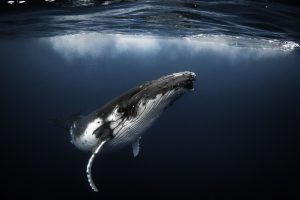
About humpback whales
The humpback whale is a large baleen whale that migrates annually along the east and west coasts of Australia from Antarctica to the warmer waters off Queensland and Western Australia to breed. Baleen means instead of teeth they have baleen plates (made from keratin like our hair and nails), which sieve food. They take huge mouthfuls of water and food, then push the water back out through the plates, leaving behind only food for ingesting.
The humpback whale is easily recognizable from the knobbly bits on their heads – each whale has a unique pattern on their tail fluke. They have the longest flippers of all whales which makes them more acrobatic and manoeuvrable – hence all the activity! Their scientific genus name Megaptera means ‘big wing ’in Greek.
Humpback whales eat small school fish and plankton whilst migrating, and only krill in Antarctica. They have learned a unique method to maximise on their prey called bubble net feeding. Working together in a team of up to fifteen whales – a group will dive below a school of prey while one or two others circle blowing bubbles from their blowholes in a spiral pattern, herding the prey into a concentrated area. The group then lunge upwards together through the bubble net with their mouths open, getting huge mouthfuls at once. This is a cultural behaviour that is learned rather than instinctual. It demonstrates a high level of social intelligence due to the complexity of the coordination and communication required to carry out such an action.
Interesting facts
- The unique knobs on their head and jaws are called tubercles and contain a single hair follicle, which senses vibrations (amazing).
- They reach sexual maturity from five to eight years of age.
- There is a twelve-month gestation period for calves.
- Females calve every two to three years.
- Calves stay with their mother for another twelve months after birth.
- They were hunted almost to extinction in the 1950’s and 1960’s for their meat and oil – east coast humpback whales were down to approximately 150.
- Protected in the southern hemisphere since 1963, with a worldwide moratorium on whaling in 1986 – humpback whales now number over 40,000.
- In 2022, they were removed from Australia’s list of threatened species.
- The streetlights of London were once powered by whale oil (horrendously).
- Humpback whales swim more slowly than others because they have stout, stocky bodies and long pectoral fins which serve them well for activities like breaching but not for high-speed travel.
- They have the longest annual migration of any mammal – up to 10,000 kms.
- They have an average life span of 45 – 50 years.
- Adult females grow 15 – 16 metres, males 13 – 14 metres.
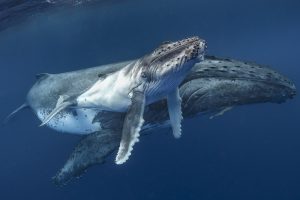
Feeding and Krill
A female humpback – in a good year – swims from Antarctica to the equator, calves, then mates and becomes pregnant again, returns to Antarctica while nursing a calf, all without eating (except for the odd small fish opportunity). The only place she really feeds is Antarctica. By then, as you can imagine, she is really, really hungry!
In the Southern Ocean humpback whales only eat krill, which is a like a tiny prawn, less than 6cm long. In the past, krill has been abundant but today, humans use it for commercial salmon feed as an additive, in pet food, and as an Omega-3 supplement. Krill is hunted by industrial size purpose-built factory ships, primarily from Norway, but also from South Korea, China, Chile, Russia and Ukraine.
The issue is that supertrawlers are taking exactly the food that the whales (as well as penguins, birds and seals) would be consuming, at the same time, in the same place, for the same small window of opportunity. This is from December to February, when the krill has its highest oil content, which whales need to build blubber, and energy reserves essential for migrating and breeding. The trawlers prefer not to travel further south, as this will cost more in fuel and time, with less volume of krill available – their goal is to be efficient and effective, as is the whales.
The krill industry has (cleverly) marketed krill oil as a desirable product “from the pristine waters of Antarctica” as a pharmaceutical food supplement. The market is predicted to rise by 10% from 2021 to 2031, which would require the current catch to almost double over this period. Krill oil is also a growing market for use in baby formula and skin-care products.
Protections in place for Krill
The international body responsible for managing the waters around Antarctica is called the Commission for the Conservation of Antarctica Marine Living Resources (CCAMLR). It was established in 1982 with the purpose of conserving Antarctic marine life – specifically to
address the increasing commercial interest in Antarctic krill, whilst allowing for sustainable harvesting. The organisation is also committed to establishing Marine Protected Areas in the Southern Ocean to protect marine life.
The CCAMLR is made up of twenty-seven members of which Australia is one. It operates on a consensus approach, meaning all members must agree before decisions can be implemented. The main point here is that the CCAMLR is responsible for both the protection of this key part of Antarctica whilst also overseeing the commercial quota of krill allocated each year and the areas to be fished.
A clear conflict of interest? It would appear so…
In 2009, in recognition of the regions’ amazing biodiversity and richness, a network of Marine Protected Areas (MPA’s) was proposed. One of which – the Antarctic Peninsula MPA – was formalised by Chile and Argentina a mere nine years later, in 2018.
Marine Park Areas
MPA’s are the equivalent of a national park at sea, where a geographical space is clearly defined and set aside to protect and maintain biological diversity, natural resources and cultural features. Regarding the Antarctic Peninsula – a proposed area of 670,000 square kms of ocean – fishing would be largely banned.
The benefits are almost inconceivable – multiple species of whales protected, the survival of some 10,000 unique species of mammals, fish and birds. Massive amounts of carbon would be sequestered (more on this next). MPA’s are also known for “spilling over” into areas around them, as populations recover, increase and flourish within the MPA and eventually expand outwards.
Conservation Measures
A Conservative Measure 51-07 (CM 51-07) was initially established in 2009 to manage krill fishing as it was feared that concentrated fishing in areas where, for example, whales feed, would have dire consequences. Management of the area was therefore clearly needed. CM 51-07 divided up the overall krill catch limit into subareas to address this. CM 51-07 was initiated as an interim solution until more research, development and planning etc. could take place.
CM 51-07 has expired multiple times, but each time has been renewed, to allow more time to finalise a complete revision of the krill fishery management approach that would incorporate new scientific practices and vitally, and include climate change in the mix. In October 2024, at the CCAMLR annual meeting in Hobart, it was hoped that a new catch krill limit would be agreed upon, in conjunction with the establishment of the Antarctic Peninsula MPA. Instead, when negotiations failed, Russia and China blocked the renewal of CM 51-07, meaning that the whole quota of krill catchment – 620,000 tonnes – could be fished in any one location. No prizes for guessing where that might be. Right where all the whales, penguins and seals’ feed. (Russia and China have blocked the proposal for the Antarctic MPA for seven years in a row, leading up to 2023).
Why?
Because an MPA will reduce their lucrative commercial fishing rights, particularly for krill.
As feared, in August 2025, the lack of the dispersal of fishing across multiple areas has resulted in, for the first time, the 620,000-tonne catch limit being reached. This ‘triggered’ the
first shut down for the season, which you would assume is a good thing. However, it merely confirms that the supertrawlers were all in the area where the krill is most concentrated hence the reaching of the total allowable catch.
The other disturbing situation is that the supertrawlers are not restricted by any regulations to maintain a safe distance from whales and other sea life. According to various ‘watchdog’ organizations, such as Sea Shepherd, Bob Brown Foundation and World Wildlife Fund, the trawlers navigate straight towards where whales are feeding because they are guaranteed to find krill there as well. This puts whales in danger of collisions, which happens occasionally but the real numbers are likely to be much higher than is reported. More often are whales getting caught in supertrawler nets, which are large enough to contain a jumbo jet, leading to the obvious point that whales would find them hard to avoid.
The immediate establishment of the Antarctic Peninsula MPA is imperative for the continued recovery of whale populations (not just humpbacks) in the face of the intensifying industrialisation of the krill fishing trade.
Krill and climate change
Krill are not only a keystone species that form the base of the food web, as the primary food source for many marine animals, but they play a critical role in addressing carbon emissions. This is because they store carbon in their bodies and transport it to the deep ocean through their waste and when they die, where it is sequestered for many years.
Krill in turn is being affected by climate change now, as temperatures rise causing sea ice to shrink, which is vital for food and shelter during their larval stage. Growth and reproduction levels are less, as well as increased levels of carbon dioxide in the ocean which increases acidity levels, also negatively affecting krill survival. Krill populations are moving southwards for survival, but this in turn impacts species like whales, seals and penguins as it reduces access to their primary source of food. Put simply: less krill means less food for whales and all the other animals that depend on it.
Whales and climate change
Whales also play a huge role in combating climate change because they poo only on the surface of the ocean, which brings nutrients from deeper water to the surface, a phenomenon known as the ‘whale pump’. Their poo floats and spreads out, fertilizing the growth of phytoplankton, which then photosynthesizes and absorbs carbon dioxide from the atmosphere. In addition, when the phytoplankton die, they sink to the ocean floor, taking the captured carbon with them.
Research suggests this figure is significant as collectively, the world’s great whale populations – each year – can capture approximately 200,000 metric tons of carbon dioxide. This is equivalent to 400,000 acres of mature, temperate forests.
The other thing that whales do for climate change is to act as carbon sinks when they die and sink to the ocean floor. One large whale can sequester 33 tons of carbon, equivalent to around 30,000 trees. If whales were protected and returned to their pre-whaling population of 4-5 million, compared to the current number of around 1.3 million today, the benefit to the planet would be enormous.
What needs to be done
Overall, the main issue is sustainability for both – business and the natural world. There is no point in the krill fishing industry blatantly plundering the Antarctic because it will only lead to the collapse of an entire ecosystem because so many species are dependent on them. Other consequences will be continued acceleration of climate change through the lack of phytoplankton, krill and whales playing their role in carbon capture. The loss of tourism, which is now a huge industry, will also be impacted. Whales are a delight to behold. Quite simply.
We are all on this planet together – people, whales, industry etc. The challenge is to create a solid balance so that each get their fair share, no one gets left behind and sustainable practices can continue to support the planet.
How we can help, as individuals
- Stop buying petfood that has fish or krill in it (or buy less), choose instead products that only contain sustainable options like chicken, turkey, beef or rabbit. Read the ingredient list for krill oil in petfood and vote with your wallet.
- Stop buying krill-based omega-3 supplements – there are plenty of plant-based alternatives to choose from instead.
- Go to savekrill.com (a Sea Shepherd campaign), where you can email Australian retailers to protest the stocking of products containing krill.
- Support organisations like the Australian Marine Conservation Society (AMCS), Sea Shepherd Global, the Antarctic and Southern Ocean Coalition (ASOC) in their work to protect our oceans.
- Advocate for strong, science-based conservation measures within the Commission for the Conservation of Antarctic Marine Living Resources (CCAMLR).
- Contact the environment minister and your local MP to demand greater protection for the Southern Ocean through establishing marine protected areas and addressing climate change.
- Personally, I love smoked salmon – who doesn’t? But instead of buying it somewhat regularly, I now have it as a rare special treat. And it must come from Denmark, never from Tasmanian fish farms.
- Likewise for salmon portions – avoid all farmed salmon – they are fed krill to make them pink.
- Push, push, push for the Antarctic Peninsula MPA to be established – write letters, emails, protest, whenever possible, use your voice to create change.
- Use a recyclable, long lasting Ecosilk Shoulder Bag to replace plastic bags, which comes in a Humpback themed pack of six, where a percentage of every pack is donated to the Australian Marine Conservation Society (AMCS), whose work is vital in protecting our oceans and all marine wildlife to ensure our coasts and oceans remain healthy and free.
Written by Emily Hay. This article is independently researched and written, and is not AI generated.